
Nag Panchami 2026: Date, Puja Vidhi, Stories, Mantras and the Deeper Meaning of Worshipping the Nagas
By Naam Jaap Editorial Team · July 7, 2026 · Reviewed July 14, 2026 · 10 min read
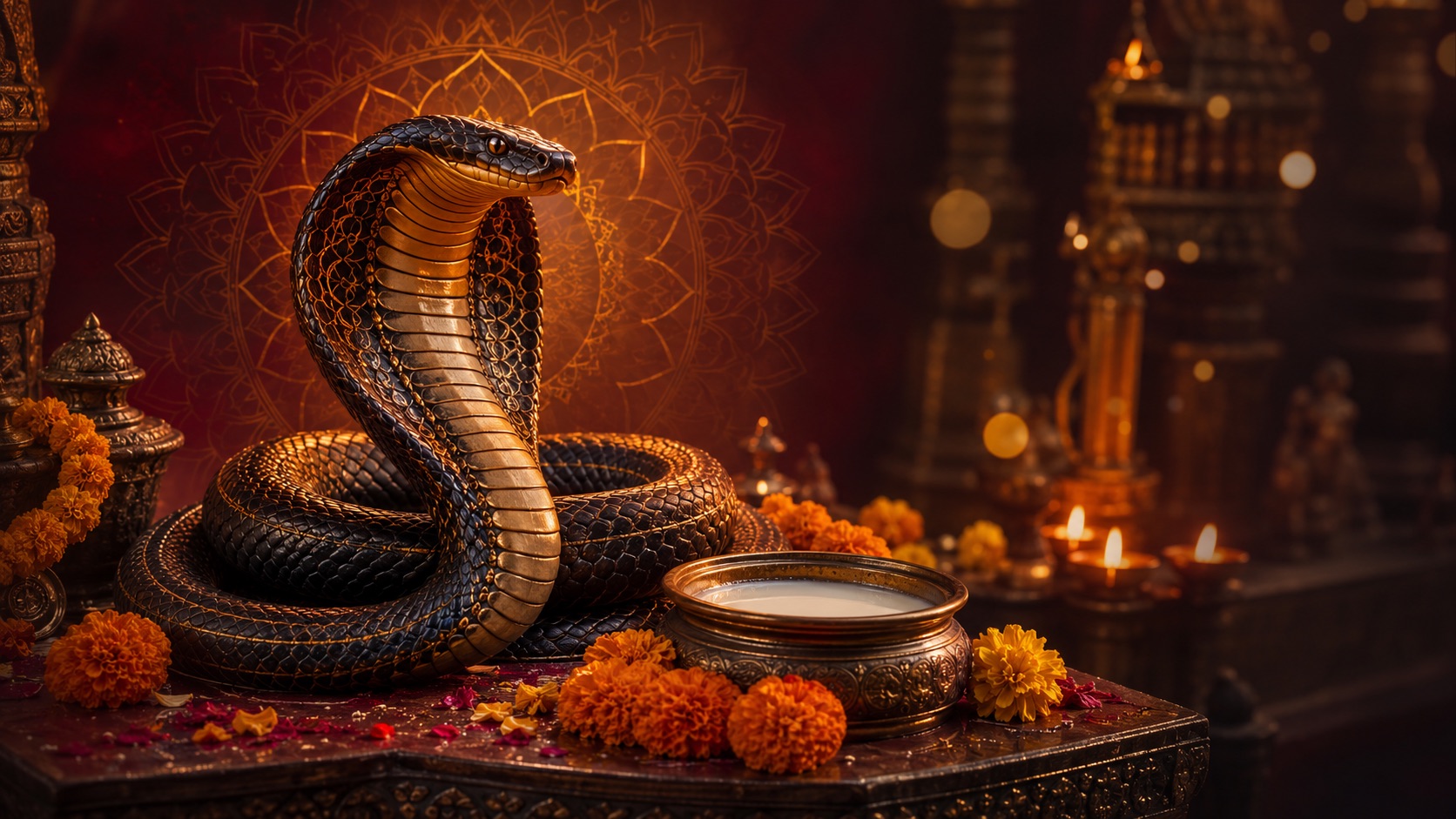
For many of us, the first memory of Nag Panchami is wonderfully simple: a small image of a snake drawn near the doorway, a bowl of flowers beside it, turmeric on our fingers, and an elder telling us not to dig the earth that day. As children, we may have been puzzled. Why would a family that warns us to stay away from snakes also fold its hands before the naga?
That apparent contradiction contains the festival's wisdom. Nag Panchami does not ask you to treat a wild snake like a pet. It asks you to recognise that fear and reverence can coexist, and that human life depends on creatures we do not fully understand or control.
Nag Panchami in 2026 falls on Monday, 17 August in much of India, on Shukla Paksha Panchami of Shravan. It coincides with a Sawan Somwar in the North Indian calendar, making the day especially meaningful for devotees of Shiva, whose iconography includes the serpent Vasuki. Dates and customs can differ in Gujarat and some other regions, so check your local Panchang and follow the tradition of your community.
Who are the nagas in Hindu tradition?
The word naga can refer to snakes and to the powerful serpent beings described in sacred stories. They are associated with water, fertility, hidden realms, protection, and cosmic power. Vishnu rests upon the endless serpent Ananta Shesha. Shiva wears Vasuki around his neck. The serpent king Takshaka appears in the Mahabharata, and the Bhagavata tradition tells of Krishna dancing upon Kaliya.
These images are not random decorations. A snake moves close to the earth, disappears into hidden spaces, sheds its skin, and returns. It became a living symbol of mystery, renewal, death, and continuity. It also plays a real ecological role by helping control rodent populations in farms and fields.
The story of Astika: when revenge was stopped
One of the most powerful stories connected with Nag Panchami begins with grief. King Parikshit died after being bitten by the serpent king Takshaka. His son, King Janamejaya, was consumed by anger and began a great sarpa satra, a ritual intended to draw all serpents into the sacrificial fire.
This was no longer justice for one death. It had become the destruction of an entire race.
The young sage Astika, born of both human and naga lineage, arrived at the sacrifice. His wisdom pleased Janamejaya, who promised him a boon. Astika asked the king to stop the ritual. Bound by his word, Janamejaya ended the sacrifice, and the remaining nagas were saved.
Pause with that story for a moment. Have you ever allowed one wound to become a judgement against everyone associated with it? One person betrays you, and you decide nobody can be trusted. One argument at home becomes a list of every old mistake. The fire of revenge always asks for more fuel. Astika represents the voice that steps between pain and collective punishment and says, “Enough.”
The story of Krishna and Kaliya
Another familiar story takes us to the Yamuna, where the serpent Kaliya had poisoned the water. Birds fell, animals suffered, and the people of Vrindavan lived in fear. Young Krishna entered the river, subdued Kaliya, and danced upon his many hoods. Yet Krishna did not kill him. When Kaliya's wives prayed for mercy, Krishna told the serpent to leave the Yamuna and live elsewhere.
The story ends not only with victory, but with restoration. The poisoned water becomes life-giving again, and destructive power is redirected rather than merely destroyed. For a modern reader, it is difficult not to think of polluted rivers. We may celebrate Krishna's cleansing of the Yamuna while allowing plastic, sewage, and chemicals to enter our own water. Nag Panchami becomes more honest when prayer is joined with responsibility.
A simple Nag Panchami puja at home
Wake early, bathe, and clean the prayer area. Place an image of the naga deities, Shiva with Vasuki, Krishna dancing on Kaliya, or Vishnu resting on Shesha. In many homes, a simple naga image is drawn with turmeric, sandalwood, geru, or natural colour on a wall or wooden board. Avoid drawing on public property or using materials that harm the surface.
Keep water, flowers, turmeric, kumkum, akshat, incense if you use it, a diya, fruit, and sweets. Some traditions offer milk symbolically to a naga image or deity. Offer only a small quantity and use it responsibly.
Take a sankalpa for protection, freedom from fear, family wellbeing, and respect for all life. Invoke Ganesha, then offer water, flowers, turmeric, and akshat. Remember the major nagas through a simple prayer. A commonly recited list honours Ananta, Vasuki, Shesha, Padmanabha, Kambala, Shankhapala, Dhritarashtra, Takshaka, and Kaliya. If Sanskrit is unfamiliar, say in your own language: “I bow to the naga deities. May there be peace between our homes and the living world.”
Chant “Om Namah Shivaya” or “Om Naga Devatabhyo Namah” 11, 21, or 108 times. Read the Astika or Kaliya story, perform aarti, and share prasad. Families may avoid digging soil, cutting trees, or ploughing on this day as a gesture of care for creatures living underground.
An important safety note about snakes and milk
Do not attempt to catch, touch, feed, or worship a wild snake directly. Snakes do not naturally drink milk, and forcing milk can cause distress or harm. Do not pay handlers who capture snakes for display; the animal may have been injured, defanged, or kept illegally. If a snake enters your home or building, keep people and pets away and contact a trained local wildlife rescuer or the forest department.
Your puja does not become less sacred because it is performed before an image rather than a live animal. In fact, protecting the living creature from fear, handling, and spectacle is closer to the spirit of reverence.
How Nag Panchami is celebrated across India
In Maharashtra, devotees may visit temples and worship naga images, and homes prepare offerings such as puran poli or regional foods. In Karnataka, Andhra Pradesh, and Telangana, ant hills and serpent shrines may receive special worship according to local custom. In parts of North India, families draw serpent forms near the entrance and listen to the vrat katha. Some communities connect the day with sisters, family protection, or agricultural rhythms. In Gujarat, Nag Panchami may be observed on a different date according to the Gujarati calendar.
There is no need to flatten these traditions into a single “correct” internet ritual. If your grandmother's method differs from a video you watched, ask what it means before assuming it is wrong. Local practice is often a library carried in people's hands.
A story from an ordinary apartment
Consider nine-year-old Kabir, who sees a snake near the parking area of his apartment building. Adults gather, someone picks up a stick, and several people begin filming. Kabir remembers the Nag Panchami story his mother told him. He asks everyone to step back while the security guard calls a rescuer. The snake is safely moved, and the rescuer explains why construction has reduced its habitat.
Later, Kabir places a flower before Krishna's Kaliya image. His puja began before the diya was lit. It began when he chose not to turn fear into violence or wildlife into a video.
What can the serpent teach a devotee?
Shed what has become too tight. A snake must leave an old skin in order to grow. We also carry identities and habits long after they stop serving us: “I am always angry,” “I can never pray consistently,” “Our family never apologises.” Nag Panchami asks what you are ready to outgrow.
Respect hidden boundaries. A snake usually does not seek human conflict; many bites occur when it is threatened, stepped on, or handled. In relationships too, respect grows when we notice space and boundaries.
Transform fear into alertness. Reverence does not mean carelessness. You can honour snakes and still keep a safe distance. Spiritually, courage is not the absence of caution; it is refusing to let panic decide your behaviour.
Protect water and soil. Naga traditions are closely tied to water bodies, rain, and the earth. Use the festival as a prompt to reduce chemical pesticides, support habitat protection, or join a local water clean-up.
If you live in a snake-prone area
Reverence should make the home safer for both people and wildlife. Keep the area around the house free of piles of scrap, rubble, and dense unmanaged growth where rodents—and therefore snakes—may shelter. Store grain and animal feed in closed containers. Use a torch outdoors at night, wear covered footwear in fields or overgrown areas, and do not place your hands into holes or dark gaps you cannot see.
Teach children one clear rule: if you see a snake, stop, step back slowly, and call an adult. Do not throw stones, crowd it, or try to identify it from close range. Save the number of a recognised wildlife rescuer or local forest authority before an emergency occurs.
If a snakebite is suspected, seek emergency medical treatment immediately. Keep the person as still and calm as possible and remove tight items such as rings. Do not cut the wound, suck out venom, apply chemicals, or rely on a mantra in place of antivenom and hospital care. Prayer can accompany responsible action; it should never delay it.
This practical caution belongs in a devotional article because dharma includes protecting life. A family that knows how to respond calmly is less likely to harm a harmless snake and more likely to get timely care when danger is real.
Common questions about Nag Panchami
When is Nag Panchami in 2026? In much of India it is observed on Monday, 17 August 2026. Check the date for your region because some local calendars differ.
Can I offer milk on Nag Panchami? You may make a small symbolic offering to a deity or image if your tradition does so. Do not pour milk into snake holes or force it on a live snake. Use food respectfully and avoid waste.
Should we avoid using a knife or digging the ground? Some families avoid cutting, frying, ploughing, or digging according to local custom. These practices vary. Follow your tradition without frightening others with claims of punishment.
Which mantra can a beginner chant? “Om Namah Shivaya” is simple and especially fitting because of Shiva's association with Vasuki. You may also offer a plain-language prayer for protection and harmony with nature.
Does Nag Panchami remove Kaal Sarp Dosha? You will see many absolute promises online. Astrological interpretations and remedies vary by tradition and chart. Do not let anyone exploit fear or guarantee life-changing results for a large fee. If astrology is important to you, consult a responsible practitioner and keep devotion free from panic.
Festivals endure because they speak on more than one level. Nag Panchami remembers sacred stories, honours family customs, and gives us a way to pray for protection. It also challenges the assumption that every creature must be useful, attractive, or harmless before it deserves a place in the world.
This year, draw the naga gently. Offer flowers. Tell a child about Astika, who stopped a fire of revenge, and Krishna, who restored a poisoned river. Then let the worship travel beyond the puja room. Save water. Refuse wildlife spectacle. Call a rescuer instead of reaching for a stick.
The most sincere way to bow before the naga may be to let it live.
Related reading
- Today's Panchang for your city
- Sawan 2026: Shravan Somwar guide
- Krishna Janmashtami 2026
- Naam Jaap mantra counter
Get festival dates & muhurat for your city
Check the exact date, tithi and shubh muhurat for your city with the free Naam Jaap Panchang.
Open the Panchang