
Krishna Janmashtami 2026: Date, Midnight Puja Muhurat, Fasting Rules, Home Celebration and Krishna's Timeless Message
By Naam Jaap Editorial Team · July 6, 2026 · Reviewed July 14, 2026 · 10 min read
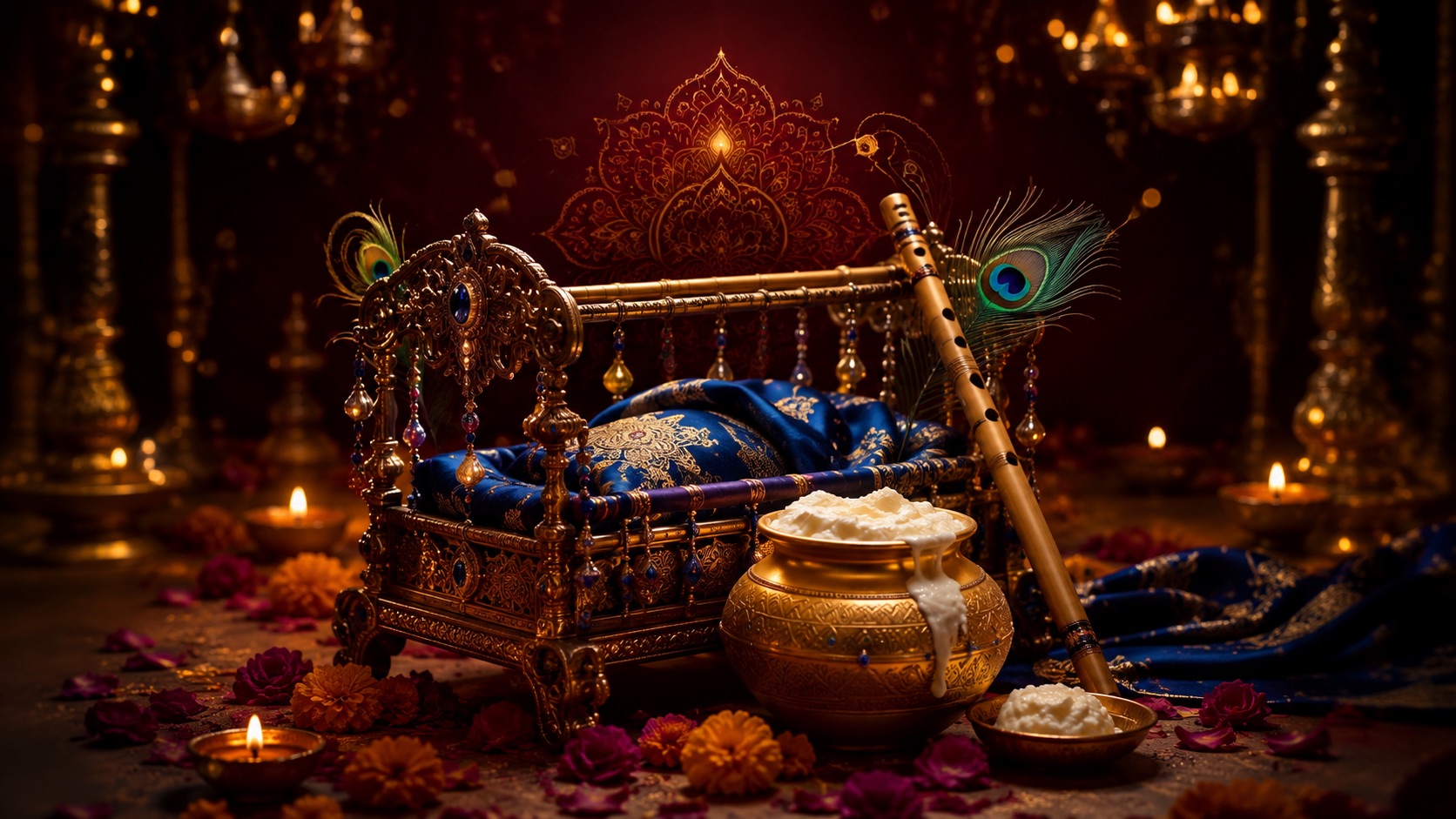
Long before midnight, the house begins to change. A blue cloth becomes the Yamuna. Cotton turns into clouds. A tiny basket waits beside a little Krishna murti, and two small footprints made from rice paste travel from the doorway toward the puja room. Children who normally resist bedtime are suddenly wide awake. Grandparents repeat a story everyone knows, yet nobody wants to skip.
Then the clock approaches twelve. The room grows quiet. A bell rings, the curtain opens, and the family calls out together: “Nand ke anand bhayo, Jai Kanhaiya Lal ki!”
Janmashtami has this rare quality. It carries philosophy deep enough for a lifetime, but it enters the home as the laughter of a child.
Krishna Janmashtami in 2026 falls on Friday, 4 September. For New Delhi, the Nishita or midnight puja window is approximately 11:57 PM on 4 September to 12:43 AM on 5 September, with the midnight moment around 12:20 AM. Timings vary by city. Some Smarta and Vaishnava traditions may apply their Panchang rules differently, so follow your temple or family tradition and check a local Panchang before publishing exact timings for a city.
The night Krishna was born
Mathura was ruled by Kansa, a king whose fear had hardened into cruelty. At the wedding of his sister Devaki to Vasudeva, a divine voice announced that Devaki's eighth child would bring about Kansa's end. Instead of changing his ways, Kansa imprisoned the couple and killed their children one after another.
When the eighth child was due, the prison was locked and guarded. Yet on the dark Ashtami night, Krishna was born. The chains fell open. The guards slept. Vasudeva placed the baby in a basket and stepped into the rain-swollen Yamuna. Shesha sheltered them while the river made way. Across the water in Gokul, Vasudeva left Krishna safely with Yashoda and Nanda and carried back the newborn girl Yogamaya.
It is a dramatic story, but notice where hope appears. Not in a palace, not in daylight, and not after every danger has passed. Krishna is born in a prison at midnight while a storm is still raging.
Perhaps that is why the story reaches people during their own difficult seasons. It does not say, “First remove every problem, then the Divine will come.” It says light can be born inside a place that still looks locked.
Preparing a simple Janmashtami celebration at home
Clean the puja area and place an image or murti of Bal Gopal, Radha-Krishna, or Krishna with a flute. A small jhula is lovely but not essential. Decorate with flowers, leaves, rangoli, or reusable cloth. Children can create a simple jhanki of Mathura, the Yamuna, and Gokul using paper, toys, and items already at home.
Keep a diya, incense if desired, water, flowers, tulsi leaves, fruit, makhan-mishri, panjiri, and other satvik offerings followed in your family. Tulsi is especially dear in Krishna worship; offer clean leaves respectfully rather than stripping a plant for decoration.
Begin the day with a sankalpa for devotion and self-mastery. Read from the Bhagavad Gita, Bhagavata Purana, or a trusted retelling of Krishna's birth. Chant a Krishna mantra during the day. In the evening, sing bhajans, tell stories, and prepare for the midnight puja without turning the home into a place of stress.
Near the Nishita time, bathe Bal Gopal gently with clean water or panchamrit if the murti is suitable for abhishek. Dry and dress the murti, offer flowers, tulsi, and bhog, and rock the jhula. Perform aarti and celebrate Krishna's birth. Some families break the fast after midnight; others complete parana the next morning according to their tradition.
If you live in a hostel or a small apartment, keep it simple. Place Krishna's picture on a clean desk, offer fruit, listen to one bhajan through headphones, and chant quietly. Vrindavan is not measured in square feet.
Janmashtami fasting without fear or competition
Many devotees fast from sunrise until the midnight birth celebration. Some observe nirjala vrat, some take water and fruit, and others eat permitted vrat foods such as sabudana, potato, fruit, milk, curd, nuts, or preparations made from non-grain flours. Rules differ among families and Vaishnava communities. Grains, pulses, onion, garlic, alcohol, and non-vegetarian food are commonly avoided.
Choose an observance appropriate for your health. Children, pregnant or nursing women, elderly people, those with diabetes, people taking medication, and anyone unwell should not be pressured into a strict fast. A doctor—not an online comment—should guide medical decisions. You can eat simple satvik meals and keep the day through japa, seva, and restraint.
Do not compare plates. One person's nirjala fast is not proof of greater love, and another person's fruit meal is not spiritual weakness. Yashoda's Krishna is moved by affection, not performance.
Mantras for Janmashtami
The Hare Krishna Mahamantra is beloved and easy to chant:
Hare Krishna Hare Krishna
Krishna Krishna Hare Hare
Hare Rama Hare Rama
Rama Rama Hare Hare
You may also chant “Om Namo Bhagavate Vasudevaya” or simply repeat “Radhe Krishna.” Choose one and stay with it for a few minutes. If you use a mala, one round has 108 repetitions; if you are new, begin with 11 or 21. A counter can help, but devotion is not a race for a screenshot-worthy number.
Try chanting as if you are calling someone you love from another room. There is attention, warmth, and expectation in the voice. Even mental japa can carry that feeling.
Four Krishna stories to bring into everyday life
Krishna and the fruit seller: A fruit seller came to Gokul, and little Krishna ran to her with grains held in his tiny hands. Most fell along the way. He placed the few remaining grains in her basket, and when she turned to leave, her basket was filled with jewels. The point is not that every offering produces material reward. It is that love does not measure the clumsy hand by what it dropped.
Krishna lifts Govardhan: When the people of Braj faced a devastating storm, Krishna lifted Govardhan Hill and everyone sheltered beneath it. A whole community gathered in safety, with Krishna holding the centre. In your family, strength may look like becoming the calm person under whom others can gather—not controlling everyone, but creating shelter.
Krishna and Sudama: Sudama brought a humble gift of flattened rice to his childhood friend. Krishna received him with such affection that poverty and status disappeared from the meeting. Janmashtami asks whether the people who knew us before our success still feel welcome at our door.
Krishna as Arjuna's charioteer: On the battlefield, Krishna did not take Arjuna's decision away. He offered wisdom, revealed a larger vision, and asked him to act with clarity. When someone you love is confused, do you immediately control their choice, or can you become a good charioteer—steady, truthful, and present?
Making Janmashtami joyful for children
Let children make the footprints, dress as Krishna or Radha if they enjoy it, or create a cardboard flute. But move beyond costume. Ask, “What do you like about Krishna?” A child may say the butter stealing, the cows, the music, or the way he protects friends. Each answer opens a conversation.
Give them a “Krishna kindness” task: share a snack like Sudama, help someone like Govardhan, care for an animal, or apologise after a quarrel. Let them place a paper peacock feather on a family board for each act. This turns a one-night festival into lived memory.
If midnight is too late for young children, celebrate earlier and let them sleep. Record the aarti or wake them only if they genuinely enjoy it. A tired, scolded child does not learn devotion from being forced to stay awake.
Celebrating without waste
Use cloth, flowers, leaves, and reusable decorations. Avoid thermocol, glitter, and single-use plastic near food or water. Make only as much prasad as your family and neighbours can eat. If you organise Dahi Handi, prioritise trained participants, sensible heights, protective equipment, hydration, and local safety rules. Courage does not require preventable injury.
You can also offer seva in Krishna's name: support a goshala that follows responsible animal-care practices, feed children through a credible organisation, clean a local water body, or donate copies of the Bhagavad Gita to a library where they will be used.
A one-day Janmashtami rhythm for busy people
If a full programme feels overwhelming, divide the day into four small moments. In the morning, offer water, fruit, and 11 repetitions of your chosen Krishna mantra. While leaving for work or study, carry one line from the Gita in mind—perhaps the reminder to focus on right action rather than becoming trapped by the result.
At lunchtime, pause for two quiet minutes before eating your vrat meal or regular satvik food. Instead of scrolling, listen to one bhajan or read a few verses from Krishna's story. In the evening, help prepare one offering, call an elder for their blessing, or ask a child to arrange the jhula. Near midnight, join the puja in person or through a trusted temple broadcast if you are alone.
The following morning, break the fast according to your custom and carry out one act of seva. This rhythm keeps the festival from becoming a frantic late-night event disconnected from the rest of the day.
For a family, place a small bowl near the altar and give everyone a slip of paper. Ask them to write one “inner Kansa”—a fear, controlling habit, or harsh response they want to work on—and one “Krishna quality” they want to strengthen, such as courage, friendship, humour, or wise action. Nobody has to read theirs aloud. Fold the slips and keep them privately in a journal after the puja. When Janmashtami returns next year, look back with kindness rather than judgement. Spiritual growth is easier to recognise when we remember where we began.
Frequently asked questions
Is Janmashtami on 3 or 4 September in 2026? Major North Indian and Vaishnava calendars place Krishna Janmashtami on Friday, 4 September 2026. Panchang conventions can differ, so follow your temple or sampradaya.
What is the midnight puja time? In New Delhi it is approximately 11:57 PM to 12:43 AM across the night of 4–5 September. Use the reader's city for an exact time.
When should the fast be broken? Some break it after the midnight puja; many Vaishnava traditions observe parana after sunrise the next day according to tithi and nakshatra rules. Follow your family or temple guidance.
What bhog can I offer? Makhan-mishri, panjiri, fruit, milk sweets, and regional satvik preparations are common. Offer what is clean, lovingly made, and suitable for your household.
Can I celebrate if I could not fast? Absolutely. Read Krishna's story, chant, offer fruit, visit a temple, or do seva. Fasting is one form of observance, not the doorway through which all devotion must pass.
The deepest Janmashtami preparation may not be the jhanki or the menu. It may be making one inner space where Krishna can be born: a little less fear, a little less pride, a little more courage to do the right thing.
At midnight, when you open the curtain before Bal Gopal, imagine opening the locked part of your own heart. The storm may not be over. The river may still look high. Take the next step anyway. Vasudeva did not see the entire road before lifting the basket; the way opened as he walked.
May Krishna's name bring playfulness to your seriousness, wisdom to your choices, and love to the places in you that have felt imprisoned for too long.
Jai Shri Krishna.
Related reading
Get festival dates & muhurat for your city
Check the exact date, tithi and shubh muhurat for your city with the free Naam Jaap Panchang.
Open the Panchang