
Hariyali Teej 2026: Date, Vrat Katha, Puja Vidhi and a Celebration of Love, Rain and New Beginnings
By Naam Jaap Editorial Team · July 14, 2026 · 10 min read
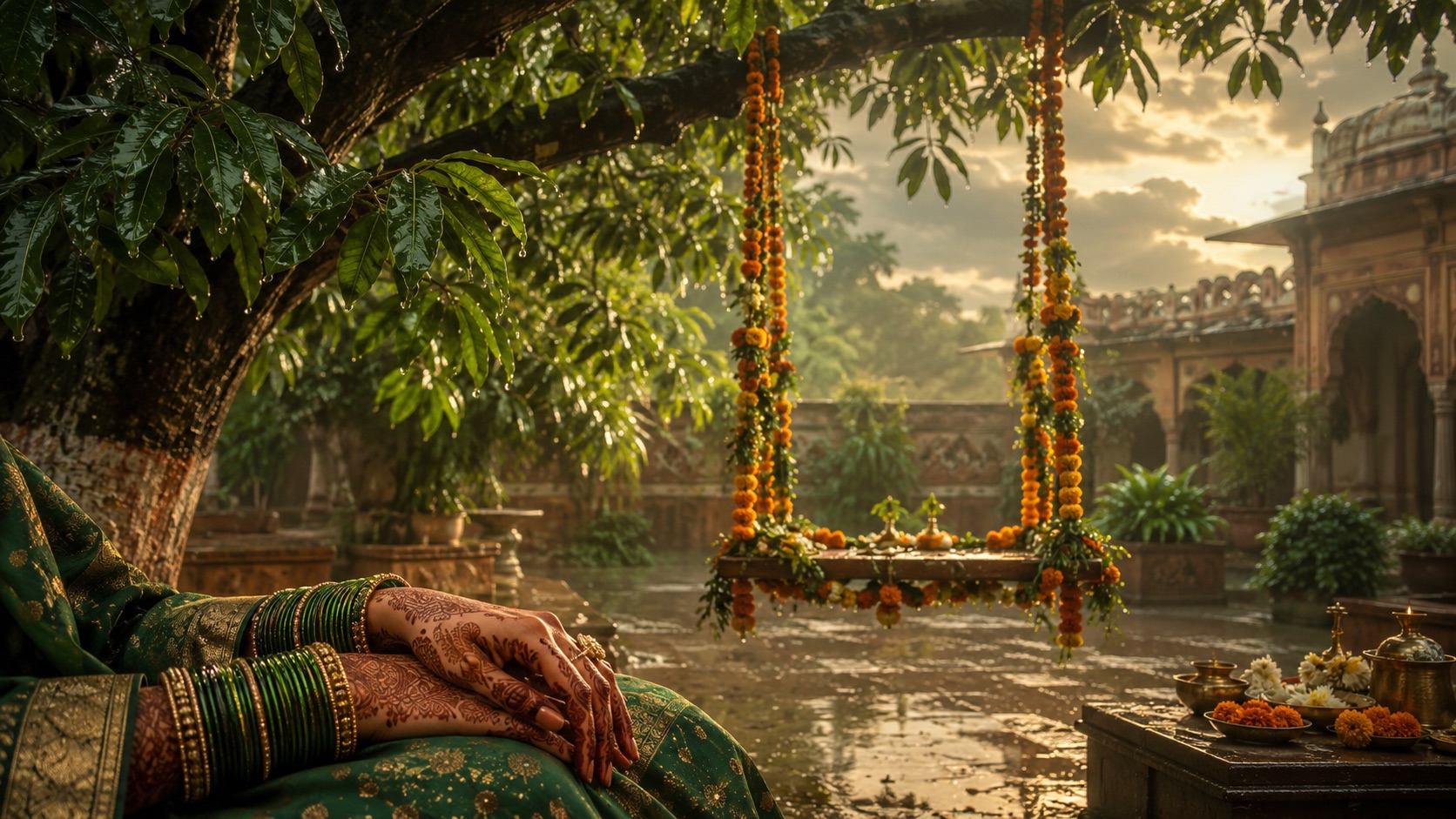
Close your eyes and picture a Sawan afternoon. The rain has just stopped. Drops are still clinging to neem leaves, green bangles chime in a courtyard, and a swing tied to a strong branch moves gently in the cool air. Someone begins an old Teej song. An aunt remembers a verse, a grandmother supplies the next line, and a little girl laughs because nobody seems to sing it quite the same way.
That is Hariyali Teej—not only a vrat written in a calendar, but a festival carried through colour, memory, friendship, rain, and the story of a love that refused to be hurried.
Hariyali Teej in 2026 will be observed on Saturday, 15 August. Tritiya Tithi begins on the evening of 14 August and ends on the evening of 15 August; exact timings vary by city, so check the Naam Jaap Panchang for your location. The festival is especially loved in Rajasthan, Uttar Pradesh, Madhya Pradesh, Bihar, Jharkhand, Haryana, and parts of Punjab, though customs differ beautifully from one family to another.
Why is it called Hariyali Teej?
“Hariyali” means greenery. After the fierce heat of summer, the monsoon gives the land its colour back. Dry branches soften, fields awaken, and the air carries the promise of renewal. Hariyali Teej falls on Shukla Paksha Tritiya in the month of Shravan, when this green transformation is visible all around us.
The festival is dedicated to Goddess Parvati and Lord Shiva. Traditionally, married women pray for the health and harmony of married life, while unmarried women may pray for a worthy partner. Yet the heart of the festival is wider than a single wish. It celebrates devotion joined with self-respect, patience joined with clear intention, and the feminine strength that can wait without becoming passive.
The story of Parvati's unwavering prayer
According to the beloved vrat katha, Goddess Parvati wished to unite with Shiva. Her resolve was not a passing desire. Through many births and long tapasya, she held her intention steadily. Shiva was an ascetic, absorbed in meditation, untouched by social status or display. Parvati did not try to win him with wealth or pressure. She refined herself through prayer, discipline, and courage.
Eventually, Shiva recognised the depth and truth of her devotion and accepted her as his equal companion. Their union is remembered not as a fairy tale in which a woman merely “gets married,” but as the meeting of Shakti and Shiva—energy and consciousness, participation and stillness, two powers that become complete in relationship without losing their own nature.
Think about how relevant that is when you are being pushed to make a life decision quickly. Perhaps relatives are asking when you will marry. Perhaps social media is showing you polished couples and making your own relationship look ordinary. Parvati's story does not tell you to suffer endlessly for someone's approval. It reminds you to become clear about what you value and not trade that clarity for impatience.
A simple Hariyali Teej puja at home
Begin by cleaning the prayer space and bathing. Many women enjoy wearing green, red, or yellow clothes, applying mehendi, and wearing bangles. These are joyful traditions, not a measure of devotion. If you are at work, travelling, grieving, or simply do not enjoy dressing up, your prayer remains complete.
Place an image or murti of Shiva and Parvati on a clean cloth. You may also shape small symbolic forms from clean clay, following your family custom. Keep water, roli, akshat, flowers, fruit, sweets, and a diya. Offer shringar items such as sindoor, bangles, a small cloth, or mehendi to Goddess Parvati if that is part of your tradition.
Sit quietly and make a sankalpa: “May there be respect, truth, patience, and wellbeing in my relationships. May I have the wisdom to give love without losing myself.” Invoke Ganesha, offer water and flowers, and worship Shiva and Parvati together. Read or listen to the Hariyali Teej vrat katha. Chant “Om Namah Shivaya” and “Om Parvatyai Namah” 11, 21, or 108 times. Perform aarti and share prasad.
If several women in your family gather, let each person take a small role. One can arrange flowers, one can read the story, one can prepare prasad, and the youngest can light an LED lamp if an open flame is unsafe. A shared puja should feel like companionship, not an examination where one person is criticised for not knowing every step.
How is the Hariyali Teej vrat observed?
Some women keep a nirjala fast without food or water, others take fruit and water, and many eat one simple satvik meal. Practices vary by health, family, and region. A strict fast is never compulsory for someone whose health does not permit it. Pregnant or nursing women, people with diabetes, those on medication, and anyone with a history of disordered eating should seek medical advice and choose a safe observance.
You can honour the vrat through moderation, prayer, and conduct. Eat simple food, step away from gossip, and give your attention to the qualities you want to bring into relationships. The purpose of a vrat is not to bargain with the Divine—“I went hungry, so please grant my wish.” It is to create a little space between impulse and action so you can see yourself more clearly.
Suppose Ananya and her husband have been arguing about money. On Teej, she keeps a fruit fast but says nothing about the real tension. He buys her a gift, photographs are taken, and by evening they are arguing again. The next year she tries a different offering. After puja, they sit together with tea and write down three shared priorities: supporting his parents, building an emergency fund, and saving for a trip. Her bangles and mehendi remain part of the celebration, but honest conversation becomes part of the vrat. Prayer opens the door; they still have to walk through it.
Traditions that make Teej feel like Teej
Green clothing reflects the renewed earth. Mehendi, whose colour deepens over time, is often associated with affection and auspiciousness. Swings recall the playfulness of the rainy season. Folk songs allow women to express longing, humour, homesickness, affection, and even complaint in a culturally shared language.
In many families, married daughters return to their maternal homes. A sindhara or gift basket may include clothes, bangles, mehendi, ghevar, fruit, and other festive items. If you exchange gifts, keep the gesture loving and within everyone's means. No daughter should feel less cherished because her family cannot afford an elaborate basket. A handwritten note, her favourite homemade snack, or time spent together can hold more tenderness than an expensive display.
Ghevar is closely associated with the monsoon and Teej in Rajasthan and North India. Other homes prepare kheer, malpua, poori-sabzi, or regional favourites. If you are fasting, prepare food safely and break the fast according to your family custom. Offer the first portion as prasad, then eat slowly; a feast after a long fast can be hard on the body.
Making Hariyali Teej meaningful for today's family
Invite the men to participate respectfully. They can arrange the puja space, cook, listen to the katha, and reflect on what mutual care looks like. Shiva and Parvati are worshipped together; the responsibility for a healthy marriage cannot rest on one person's fast.
Include women without asking painful questions. A gathering may include someone who is unmarried by choice, divorced, widowed, facing infertility, or struggling in her marriage. Do not reduce her worth to marital status. Offer warmth without advice she did not request.
Connect the celebration to actual greenery. Plant a native sapling where it can be cared for, support a local water-conservation effort, or spend the morning cleaning a shared green space. The monsoon is not merely a decorative background for photographs; it is a life-giving cycle that deserves our care.
Record an elder's song. Ask your grandmother or mother to sing the Teej verse she remembers and save the audio with her name and the place she learned it. Years later, that recording may become one of the family's most precious festival inheritances.
Create a relationship sankalpa. Choose one practical promise: no phones during dinner, one honest budget conversation each month, a weekly call to parents, or no insulting language during disagreements. A sacred promise should be small enough to live, not grand enough only to announce.
A gentle Teej gathering plan
If you are hosting Teej for the first time, do not try to reproduce a wedding-sized event. Invite a few people and ask each to bring one thing that carries a memory: a song, a family recipe, an old photograph, or a short story about the woman who taught her a tradition. Begin with tea or nimbu pani, apply mehendi if everyone wishes, and keep the puja at a clearly announced time so fasting guests are not left waiting.
After the katha, invite each person to name one quality she wants to cultivate during the coming season. Someone may choose patience; someone else, financial independence; another, the courage to ask for help. Write the words on green paper leaves and arrange them around the altar or a potted plant. The activity is simple, but it allows celebration to include the real lives in the room.
Keep gifts optional and food portions sensible. Send prasad to a neighbour who could not attend. Before everyone leaves, take a group photograph—but also put the phones away for one full song. Festivals become memories through participation, not only documentation.
Questions readers often ask
Is Hariyali Teej only for married women? It is traditionally centred on women's prayers for marital wellbeing and a good partner, but anyone may worship Shiva-Parvati and celebrate the monsoon, devotion, and renewal. Follow local and family customs with respect.
Are Hariyali Teej and Hartalika Teej the same? No. Hariyali Teej falls in Shravan and celebrates monsoon greenery and the union of Shiva-Parvati. Hartalika Teej comes later, in Bhadrapada, with its own vrat katha and observances. Kajari Teej is another distinct Teej.
What if I cannot keep nirjala vrat? Choose fruit, water, or a simple meal according to your health. You can also observe restraint in speech, spending, or screen use. Do not risk illness to prove devotion.
Can I do the puja alone? Yes. Light a diya, offer water and flowers, read the katha, and chant with attention. A quiet puja in a rented room can be as sincere as a large family gathering.
What should I pray for? Pray not only to “keep a relationship forever,” but for the qualities that make a relationship worthy of keeping: safety, mutual respect, humour, courage, truth, affection, and the wisdom to seek help when needed.
When you sit on a swing, you move forward and backward, yet the rope remains held at the centre. Relationships are like that. There are seasons of closeness and distance, certainty and confusion, celebration and ordinary work. A spiritual centre does not freeze the movement; it helps you move without losing your grounding.
This Hariyali Teej, wear green if it brings you joy. Sing even if you forget half the words. Share ghevar, call the person you miss, and offer a flower to Parvati. Then ask yourself one honest question: what kind of love am I practising in the small moments no one photographs?
That answer may be your most meaningful Teej offering.
Related reading
- Today's Panchang for your city
- Sawan 2026: Shravan Somwar dates & puja guide
- Nag Panchami 2026
- What is Rahu Kaal?
Get festival dates & muhurat for your city
Check the exact date, tithi and shubh muhurat for your city with the free Naam Jaap Panchang.
Open the Panchang