Aditya Hrudayam Stotram: Meaning, Sage Agastya's Advice to Ram & Sun Worship
By Naam Jaap Editorial Team · July 22, 2026 · 5 min read
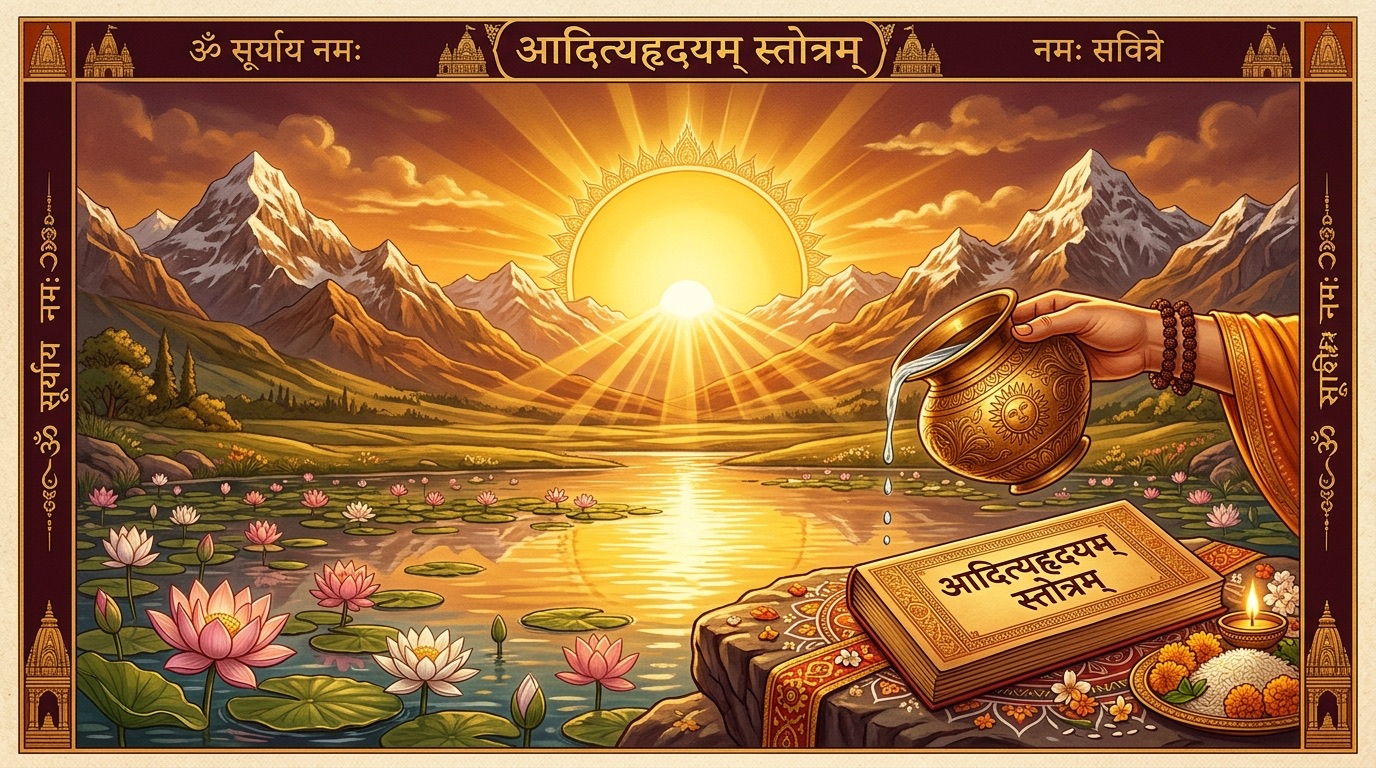
Picture a dusty battlefield. You have fought for days, endured great strain, and now your fiercest opponent steps forward for the final encounter. For a moment, exhaustion touches the heart. This is precisely the scene in the Yuddha Kanda of Valmiki's Ramayana. Sri Ram stood before Ravana, weary in body and mind, when the sage Agastya came to him and gave him a supreme hymn to the Sun — the Aditya Hrudayam Stotram. Reciting it, Ram felt courage and clarity return, and soon after, he prevailed.
This is why the Aditya Hrudayam has been loved for centuries: it is a hymn given not in comfort but in fatigue, meant to rekindle strength when a person is tired, fearful or close to giving up.
What "Aditya Hrudayam" means
Two Sanskrit words carry the meaning:
- Aditya — the Sun (a descendant of Aditi), the source of light, warmth and life.
- Hrudayam — the heart, or that which lives at the very core.
So Aditya Hrudayam is "the heart of the Sun" — the secret that lives within the light. On an inner level, the Sun stands for the Self, for confidence, vitality and steadiness. To recite the hymn is not only to honour a distant star, but to rekindle the sun of courage within your own heart.
Why the sun is invoked for tiredness and fear
In yoga and Ayurveda, the Sun is associated with the pingala channel of active energy and the manipura (solar-plexus) centre of willpower — the same centre we describe in our guide to the seven chakras. When a person feels drained, hesitant or afraid, this inner "solar" energy is felt to be low: they feel cold, uncertain, without drive. Reciting or listening to the Aditya Hrudayam is traditionally said to:
- Dissolve self-doubt — as the morning sun clears fog, the hymn is said to lift hesitation and fear.
- Restore vitality — kindling inner agni (fire), warmth and energy.
- Steady the will — supporting clear decisions, which is why students and those facing hard challenges keep it.
These are the fruits devotees describe from sincere, regular practice — a support for courage, not a substitute for rest, medicine or honest effort.
A few of the verses
The Aditya Hrudayam has 31 verses. Three of the most quoted:
"Sarva-shatru-vinaasham jaya-avaham japa nityam, akshayam paramam shivam."
"Recited daily, this hymn destroys all enemies, brings victory, and grants imperishable, supreme good."
The "enemies" here are read inwardly as well — anger, delay, envy and fear. Daily discipline clears these inner roadblocks first.
"Esha brahma cha vishnush-cha shivah skandah prajaapatih…"
"He, the Sun, embodies Brahma, Vishnu, Shiva, Skanda, Prajapati…"
The verse teaches that the light sustaining the universe is one; to turn toward the source of light is to align with the whole of creation.
"Asmin kshane mahaabaaho raavanam tvam vadhishyasi…" — the sage's assurance to Ram that, strengthened by this prayer, he will meet the moment before him.
How to practise it in daily life
You do not need a battlefield to benefit. Facing exams, a career change, a recovery or a hard season, try this simple morning practice:
- Time. Early morning, around sunrise, is traditional — the pre-dawn hours are especially calm.
- Offer water (arghya). Fill a clean copper vessel with water, add a little kumkum or a red flower, and slowly pour it toward the rising sun, looking through the stream of water.
- Face east, standing straight with hands folded at the heart.
- Recite or listen. Recite the 31 verses with devotion; if you don't know the Sanskrit, follow a clear recording while reading an English or Hindi translation.
- Rest in the light. Afterwards, take three slow breaths and let the gentle morning sun rest on your face.
If Sanskrit feels difficult at first, begin as you would with any hymn — a little each day. You may also enjoy the Gayatri Mantra, itself a prayer to the light, and the Shiv Tandav Stotram for devotional intensity.
Related reading
- Gayatri Mantra meaning, word by word
- Shiv Tandav Stotram: meaning and story
- Hanuman Chalisa: meaning and how to recite
- Brahma Muhurta: the sacred pre-dawn hour
Keep a Hanuman Chalisa sadhana
Read the Chalisa, track each recitation and complete a 40-day sadhana with the free app.
Get it on Google Play