
Shiv Tandav Stotram: Meaning, the Story of Ravana, and Why It Still Moves Devotees
By Naam Jaap Editorial Team · July 22, 2026 · 6 min read
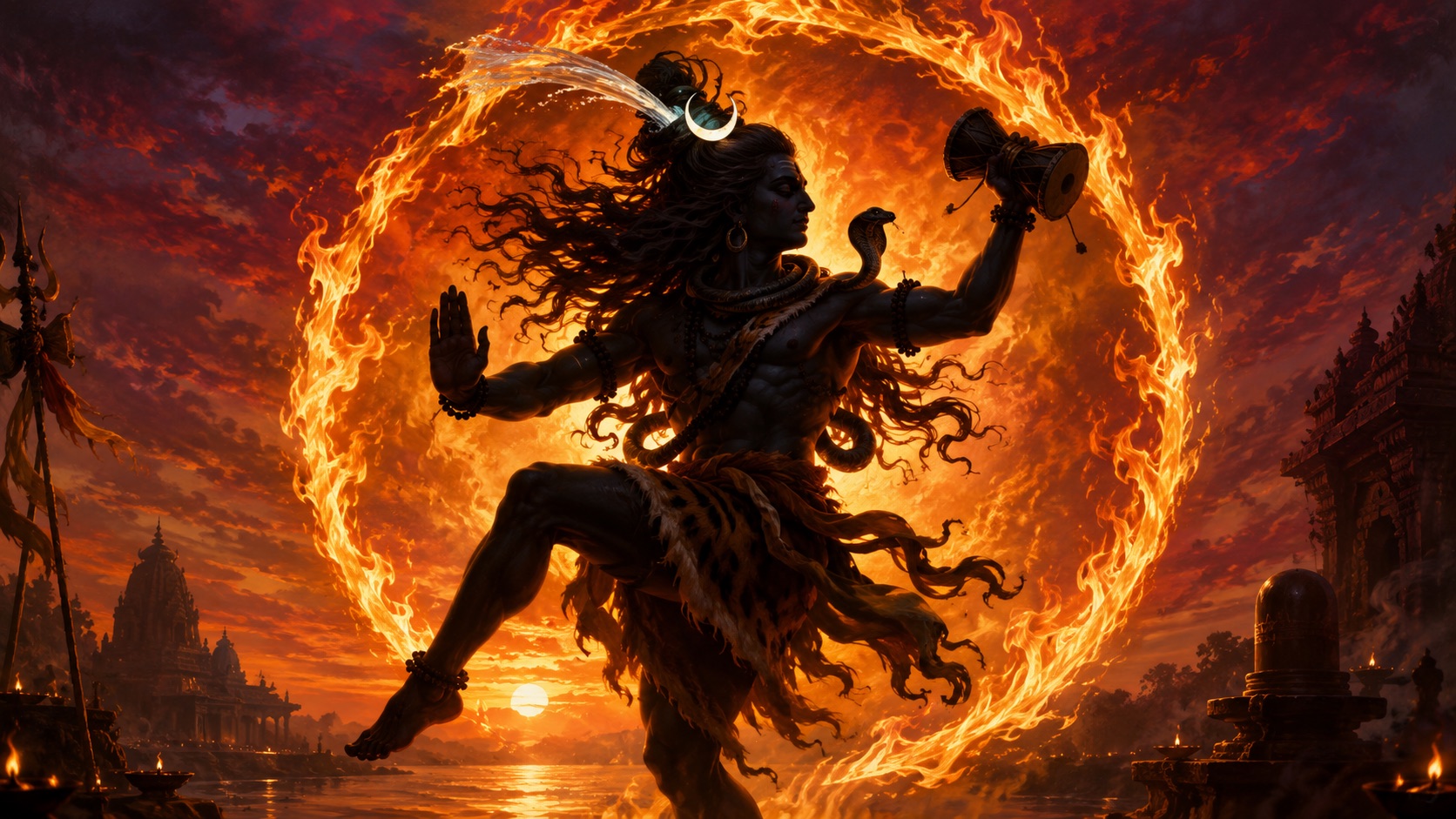
Few hymns in the devotional world hit quite like the Shiv Tandav Stotram. The moment its galloping rhythm begins — "Jatatavigalajjala pravaha pavitasthale" — something in the chest lifts. It is thunderous, fast and almost impossible to sing calmly, which is exactly the point: this is a hymn of raw, ecstatic surrender to Shiva. This guide explains what the Shiv Tandav Stotram is, the extraordinary story behind it, what it means, and how devotees recite it — especially during the sacred month of Sawan.
What is the Shiv Tandav Stotram?
The Shiv Tandav Stotram is a Sanskrit hymn of praise to Lord Shiva, celebrated for its powerful poetry and its driving, drum-like metre. The tandava is the cosmic dance of Shiva — the dance through which the universe is created, sustained and dissolved. The stotram describes this dance and the fearsome, beautiful form of Shiva in a torrent of vivid imagery: the Ganga cascading through his matted locks, the serpent garlands, the crescent moon on his brow, the fire and ash, the roar of the damaru drum.
Unlike a slow, meditative chant, the Shiv Tandav is meant to be felt as motion. Its metre imitates the rhythm of Shiva's dance itself, which is why even people who do not understand a word of Sanskrit are moved when they hear it.
The story of Ravana and the hymn
Tradition attributes the Shiv Tandav Stotram to Ravana, the ten-headed king of Lanka — better known as the antagonist of the Ramayana. This surprises many people, and it carries a beautiful teaching.
The story goes that Ravana, proud of his immense strength, once tried to lift Mount Kailash, the abode of Shiva, to carry it back to Lanka. Shiva, seated on the mountain, simply pressed down with his toe, trapping Ravana beneath the enormous weight. In agony and unable to free himself, Ravana did not rage or despair. Instead, he began to sing — pouring out spontaneous verses of praise so full of devotion and poetic genius that they became the Shiv Tandav Stotram.
Moved by this surrender, Shiva released him and blessed him. The lesson devotees draw from this is striking: even the most flawed being, crushed by the weight of his own pride, can be lifted by sincere devotion. The hymn is a reminder that bhakti is not reserved for the perfect.
The opening verse and its meaning
The most famous lines open the hymn:
Jatatavigalajjala pravaha pavitasthale
Galeavalambya lambitam bhujangatunga malikam
These lines paint the picture of Shiva with the sacred river Ganga flowing through the dense forest of his matted hair, sanctifying the ground, while a garland of majestic serpents hangs from his neck. Verse after verse builds this image — the moon, the elephant-skin, the third eye of fire, the trident, Parvati at his side — until the listener is standing before the full, overwhelming vision of Mahadeva.
The hymn is not asking Shiva for wealth or favours. It is pure stuti — praise for its own sake, love expressed as description. That is what gives it such momentum: it is a devotee simply unable to stop naming the beauty of the beloved.
Benefits devotees associate with the stotram
Reciting the Shiv Tandav Stotram is traditionally associated with:
- Focus and energy — its rhythm naturally gathers a wandering mind and lifts a heavy mood.
- Courage — many recite it to steady themselves before something difficult.
- Devotional intensity — it is a fast route into feeling, useful when the heart feels dry.
- Connection to Shiva, especially on Mondays and during Sawan and Maha Shivaratri.
It is worth being honest here: these are the fruits of sincere, regular practice and attention, not a magic formula. The stotram concentrates devotion; it does not bypass life. Approach it as a way to turn the heart toward Shiva, and let the calm, courage and clarity be a natural result.
How and when to recite it
You do not need to be a Sanskrit scholar to begin. Here is a simple approach:
- Learn it slowly. Start by reading a reliable transliteration and listening to a clear recitation. Take one or two verses at a time — the full hymn has around 17 verses.
- Do not chase speed. The famous fast versions come after familiarity. Accuracy and feeling matter more than pace.
- Choose a good time. Early morning after a bath, or evening during the Pradosh period, are traditional. Mondays (Somvar) and the month of Sawan are especially dear to Shiva devotees.
- Pair it with a simple offering — water on the Shivling, a bilva (bel) leaf, a lit lamp — and the mantra Om Namah Shivaya.
If the full stotram feels like too much at first, begin with the five-syllable mantra Om Namah Shivaya or the Mahamrityunjaya Mantra, and let the Tandav come once your tongue and heart are ready.
Why this hymn still moves people
In an age of noise, the Shiv Tandav Stotram offers a different kind of loudness — the loudness of surrender. It does not ask you to be composed. It invites you to be swept up, to feel small before something vast, and to discover that being small before Shiva is not diminishing but freeing. Ravana learned that under a mountain. Most of us learn it more gently, one verse at a time.
Related reading
- Sawan 2026: Shravan Somwar dates and Shiv puja
- Om Namah Shivaya: meaning of the five syllables
- Mahamrityunjaya Mantra meaning
- Hanuman Chalisa: meaning and how to recite
Keep a Hanuman Chalisa sadhana
Read the Chalisa, track each recitation and complete a 40-day sadhana with the free app.
Get it on Google Play