The Seven Chakras: A Beginner's Guide to the Body's Energy Centres
By Naam Jaap Editorial Team · July 22, 2026 · 6 min read
You have probably heard the word "chakra" in a yoga class, a meditation app or a passing conversation about feeling "blocked". It sounds mystical, and the internet often makes it more complicated than it needs to be. At its heart, the chakra system is a simple, practical map of the inner body — a way of noticing where your energy, attention and emotion tend to gather, and how to bring them back into balance. This guide explains the seven main chakras in plain language, without hype and without promising miracles.
The word chakra comes from Sanskrit and means "wheel" or "disc". In the yogic and tantric traditions, chakras are described as spinning centres of subtle energy (prana) arranged along the spine, from its base to the crown of the head. You cannot dissect them out of the body the way you can a bone or an organ. They are best understood as an experiential map — a language for parts of yourself you already feel but rarely name.
What the chakra system actually is
Ancient texts such as the Sat-Chakra-Nirupana and the Yoga Upanishads describe energy flowing through channels called nadis, the three most important being ida, pingala and the central sushumna. Where these channels meet, energy concentrates — and those meeting points are the chakras. Awakening and steadying this energy is part of what many meditation and pranayama practices are quietly working on.
It helps to treat the chakras as a diagnostic and devotional tool rather than a scientific claim. When you feel ungrounded, anxious, unable to speak your truth or closed to others, the chakra map gives you somewhere specific to place your attention. That focus is the real value.
The seven main chakras, one by one
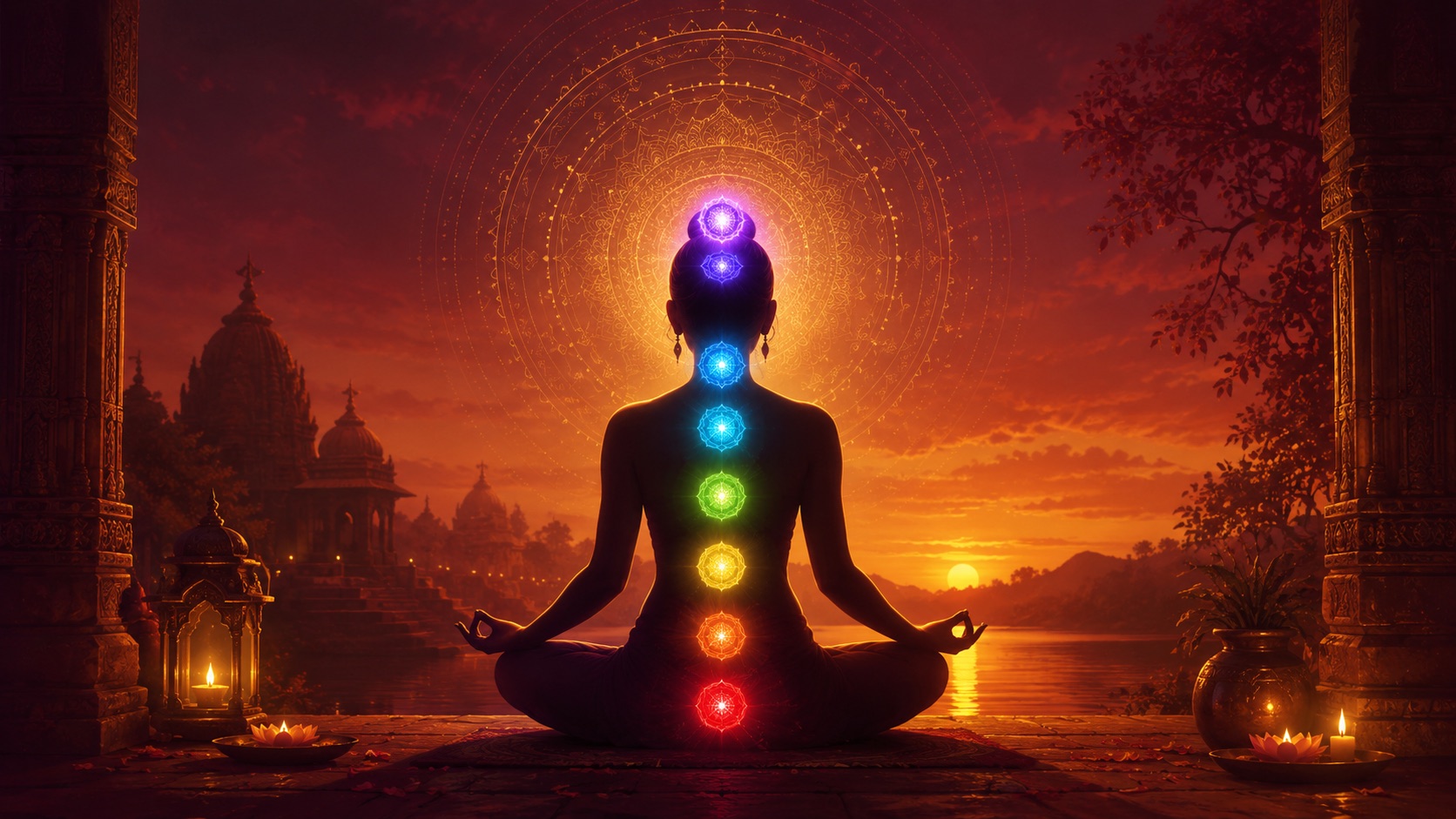
Each chakra is linked to a location, a colour, a seed (bija) mantra and a set of themes. Here is the traditional overview.
| Chakra | Location | Colour | Bija mantra | Theme |
|---|---|---|---|---|
| Muladhara (Root) | Base of spine | Red | LAM | Safety, grounding, survival |
| Svadhisthana (Sacral) | Below the navel | Orange | VAM | Emotion, creativity, pleasure |
| Manipura (Solar plexus) | Above the navel | Yellow | RAM | Willpower, confidence, digestion of life |
| Anahata (Heart) | Centre of the chest | Green | YAM | Love, compassion, connection |
| Vishuddha (Throat) | Throat | Blue | HAM | Truthful speech, expression |
| Ajna (Third eye) | Between the eyebrows | Indigo | OM | Insight, intuition, clarity |
| Sahasrara (Crown) | Top of the head | Violet / white | Silence / OM | Awareness, connection to the divine |
Muladhara — the root
This is your foundation. When the root feels steady, you feel safe, patient and able to trust that your basic needs will be met. When it is unsettled, you may feel anxious, restless or fearful about money, home and health. Walking barefoot on the earth, steady breathing and a settled daily routine all speak to this centre.
Svadhisthana — the sacral
The seat of feeling and creativity. A balanced sacral chakra shows up as healthy emotion and the ability to enjoy life without being ruled by craving. Imbalance can look like numbness on one side or emotional overwhelm on the other.
Manipura — the solar plexus
Your inner fire. This is confidence, discipline and the courage to act. When it is strong you follow through; when it is weak you may procrastinate or feel powerless. This is the chakra that a steady daily practice quietly strengthens.
Anahata — the heart
The bridge between the lower, worldly chakras and the higher, spiritual ones. This is love — not only romantic love, but compassion, forgiveness and warmth. Devotional chanting is often felt right here, in the centre of the chest.
Vishuddha — the throat
Truthful, kind expression. A balanced throat chakra lets you say what is real without cruelty and listen without defensiveness. Chanting aloud, singing bhajans and simply speaking honestly all serve this centre.
Ajna — the third eye
Insight and inner seeing. This is where meditation, focus practices such as trataka, and the sound OM are traditionally directed. A clear third eye is less about visions and more about seeing your own life without illusion.
Sahasrara — the crown
The thousand-petalled lotus at the top of the head, associated with pure awareness and union with the divine. In most traditions this is not something you force open; it opens quietly as the other centres come into balance and the ego softens.
A simple chakra meditation you can try today
You do not need special equipment or years of training to begin. Try this ten-minute practice:
- Sit comfortably with a straight spine, hands resting easily.
- Take a few slow breaths and let the body settle.
- Bring your attention to the base of the spine (Muladhara). Rest there for a few breaths, silently sensing steadiness.
- Slowly move your attention upward — sacral, solar plexus, heart, throat, third eye, crown — pausing at each centre for three or four breaths.
- Optionally, chant the seed mantra of each centre once or twice (LAM, VAM, RAM, YAM, HAM, OM).
- Finish by resting in the whole body at once, breathing gently.
A mandala can be a wonderful support here — its concentric rings mirror the ascending centres, and colouring or gazing at one naturally draws the mind inward.
Signs of balance and imbalance
The point of the chakra map is not to diagnose yourself with a broken heart chakra and worry about it. It is to notice, gently. Feeling ungrounded and anxious? Give attention to the root. Struggling to speak up? The throat. Feeling cut off from others? The heart. The framework simply turns a vague "something feels off" into a place you can bring breath, attention and prayer.
An honest note on expectations
Chakra work is a contemplative practice, not medical treatment. It can support calm, self-awareness and devotion, but it does not replace a doctor, therapist or medicine when those are needed. Approach it the way you would any inner practice — with patience, curiosity and no pressure to "open" anything on a schedule.
Related reading
- What is a mandala? Meaning and use in meditation
- What is Naam Jaap? A beginner's guide
- How to start Naam Jaap daily
- The free Mandala app
Colour a mandala, quiet the mind
200+ hand-tuned designs and a calm, offline space in the free Mandala app — now on Google Play.
Get it on Google Play