
Trataka (Candle Flame Meditation): Benefits, Safe Practice & Building Deep Focus
By Naam Jaap Editorial Team · July 22, 2026 · 6 min read
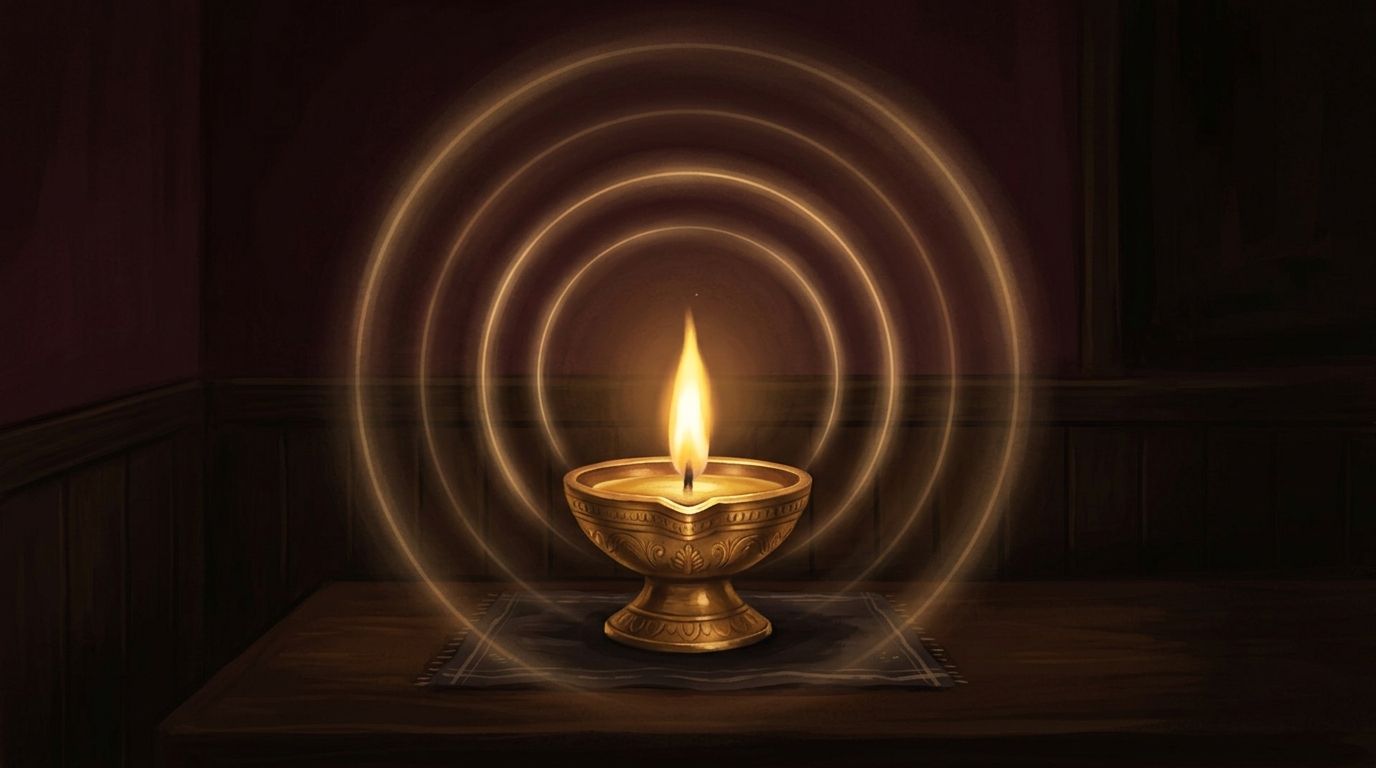
In our hyper-connected world, our eyes and minds are under constant siege. From the moment we wake until we fall asleep, we scroll through bright screens, jump between endless tabs, and absorb thousands of rapid visual notifications. The result is a condition the yogic texts described centuries ago as chitta vritti — a restless, scattered mind that struggles to hold a single thought for more than a few seconds.
If you have ever sat down to meditate or chant only to find your eyes twitching and your mind racing toward your to-do list, there is an ancient practice designed for exactly this: Trataka, or steady-gaze meditation. Described in foundational Hatha Yoga texts such as the Hatha Yoga Pradipika and the Gheranda Samhita, Trataka is the practice of gazing at a single point — most often a lit ghee lamp or candle flame — without blinking, until the eyes gently water.
The gaze and the mind
In yogic psychology there is a direct connection between the eyes and the mind. When the mind is anxious, the eyes dart rapidly from side to side; when you rest your gaze steadily on a single point, the mind tends to settle with it. By training the physical eyes to remain still, you send a quieting signal to a restless mind. Trataka acts as a bridge between posture (asana) and deeper meditative absorption (dharana and dhyana) — which is why it pairs so naturally with a chakra or breath practice.
The two stages of Trataka
1. Bahiranga Trataka — outer gazing
In this first stage you fix your physical gaze on an external object — a lit flame, a black dot on a white wall, a crystal, or a sacred symbol such as an Om or a mandala. You gaze steadily, without straining, until the eyes naturally moisten and tears begin to flow.
2. Antaranga Trataka — inner gazing
When you close your eyes after outer gazing, an after-image of the flame appears in the space between the eyebrows (the ajna, or third-eye centre). In this stage you hold your inner attention gently on that luminous point. Traditionally this is said to develop steadiness, memory and intuition.
Benefits practitioners describe
Approached patiently, Trataka is valued for several reasons — honestly stated, as effects many practitioners notice rather than guaranteed cures:
- Sharper concentration (ekagrata). Training the eye to stay still trains the mind to ignore distraction, which many find improves attention span and focus.
- Relief from screen fatigue. Gazing at a soft, warm flame stimulates the tear glands, which can wash away dryness and strain from artificial light. (It is a rest for tired eyes, not a treatment for eye disease.)
- A calmer mind before sleep. Practised in a dark room in the evening, Trataka can be quietly settling for a busy or anxious mind.
- Deeper devotional focus. In the yogic tradition it is associated with awakening the ajna centre and steadying the will — a support for prayer and meditation.
If you have a medical or psychological condition, treat these as complements to — never replacements for — proper care. See the safety notes below.
How to practise Trataka safely at home
Preparation and setup
- Choose the light. A traditional ghee lamp (diya) with a cotton wick gives a soft, smokeless golden flame and is ideal. A plain, unscented candle also works.
- Set the height. Place the lamp so the flame is at eye level when you sit — you should not have to tilt your head up or down.
- Set the distance. Position it about an arm's length (roughly 3 feet / 1 metre) away.
- Still the air. Turn off overhead lights, close the curtains, and make sure no fan or draft is making the flame flicker. A dancing flame tires the eyes.
A simple 15-minute flow
- Sit and settle (1 min). Sit cross-legged or on a chair with the spine easy and shoulders relaxed. Close the eyes and take five slow breaths.
- Outer gazing (3–5 min). Open the eyes and rest your gaze gently on the brightest tip of the flame, just above the wick. Keep the eyelids relaxed — don't stare aggressively. Try not to blink; if tears come, let them flow.
- Inner gazing (5–7 min). When the eyes feel tired or start to stream, gently close them and look toward the space between the eyebrows. Rest your attention on the glowing after-image of the flame until it naturally fades.
- Palming (2 min). Rub your palms together until warm, then cup them gently over the closed eyes without pressing. Feel the warmth relax the eye muscles, then lower your hands slowly.
Safety rules for beginners
Trataka is gentle, but respect these precautions:
- Never strain. If the eyes burn or feel painful, close them at once. This is meditation, not an endurance contest — start with just 2–3 minutes of gazing and build up over weeks.
- Keep the flame steady. No draft or fan; a violently flickering flame causes fatigue and headaches.
- Some conditions should avoid candle gazing. If you have glaucoma, epilepsy, are recovering from eye surgery, or live with a severe psychiatric condition, skip outer gazing. Practise inner Trataka instead — simply picture a peaceful golden flame with the eyes closed — and check with your doctor first.
- Remove glasses or contact lenses before you begin.
Combining Trataka with Naam Jaap
One of the loveliest ways to deepen a daily practice is to join Trataka with naam jaap. While holding your gaze on the flame, silently chant your chosen name in rhythm with the breath — Om, Ram, Om Namah Shivaya or Radhe Radhe. The flame anchors the sight while the mantra anchors the hearing; with both turned toward the divine, the mind settles far more easily than either can manage alone. If you are new to chanting, our guide on how to start naam jaap daily pairs well with this.
Related reading
- The seven chakras: a beginner's guide
- What is a mandala? Meaning and use in meditation
- How to start Naam Jaap daily
- The free Mandala app
Colour a mandala, quiet the mind
200+ hand-tuned designs and a calm, offline space in the free Mandala app — now on Google Play.
Get it on Google Play