
What Is a Mandala? Meaning, Symbolism, and Its Use in Meditation
By Naam Jaap Editorial Team · July 5, 2026 · 5 min read
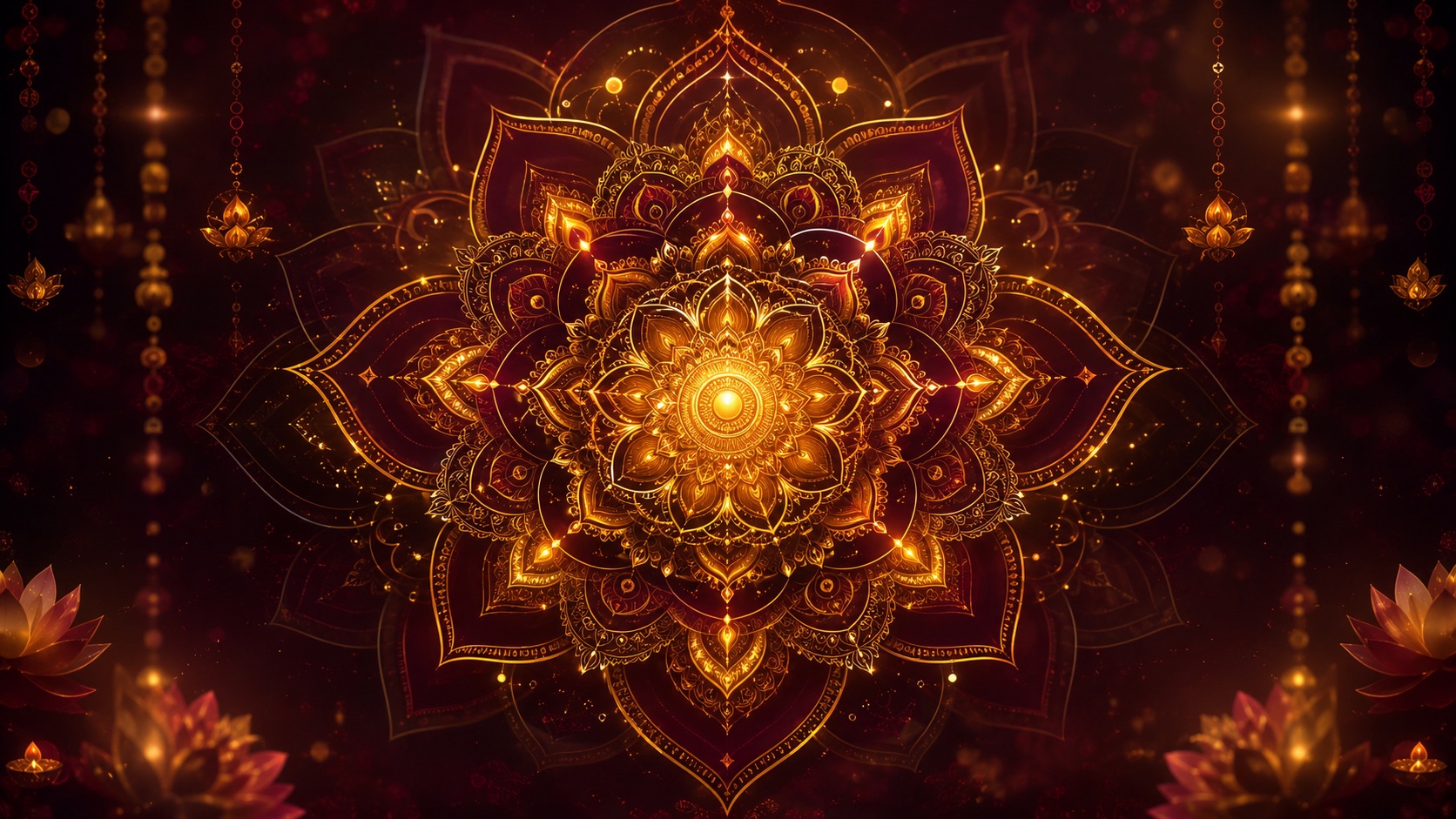
You've almost certainly seen a mandala — an intricate, symmetrical, circular design that seems to pull your eye toward its centre. But a mandala is far more than decoration. For centuries it has been a tool for focus, meditation, and contemplating wholeness. Here's what a mandala really means, where the tradition comes from, and how you can use one to settle a busy mind.
What is a mandala?
The word mandala comes from Sanskrit and means, quite simply, "circle." But in spiritual traditions it carries a much richer sense: a mandala is a geometric, usually circular design that represents wholeness, the cosmos, and the harmony of the universe.
At its heart, a mandala expresses a single idea — that everything radiates from and returns to a centre. The patterns move outward in balanced, repeating layers, drawing the viewer's attention inward toward that still point.
The symbolism of a mandala
Every part of a mandala carries meaning:
- The centre represents the origin — the source, the divine, or the self. Meditation on a mandala moves the mind toward this centre.
- The circle symbolises wholeness, unity, and the infinite — it has no beginning and no end.
- Symmetry and balance reflect the order and harmony of the cosmos.
- The layers and gateways (often square borders with four "gates") represent the journey from the outer world inward toward the centre.
Because of this, mandalas are often described as a map of the universe and, at the same time, a map of the inner self.
Where do mandalas come from?
Mandalas appear across many cultures and traditions:
- Hinduism — Mandalas and yantras (geometric diagrams like the Sri Yantra) are used in worship, ritual, and meditation to focus devotion and represent cosmic energies.
- Buddhism — Tibetan Buddhist monks create extraordinary sand mandalas, painstakingly built grain by grain and then ritually swept away — a powerful teaching on impermanence.
- Beyond religion — The psychologist Carl Jung saw the mandala as a symbol of the self and used mandala drawing in therapy. Today, mandalas are widely used in art, mindfulness, and relaxation.
Mandalas and meditation
The mandala's design is what makes it such a natural aid to meditation. Its symmetry gives the restless mind a gentle, ordered place to rest, and its centre offers a single point of focus.
There are two common ways people use mandalas to find calm:
1. Gazing meditation
Sit comfortably and let your eyes settle on the centre of a mandala. As thoughts arise, keep returning your attention softly to the pattern. The balanced design naturally quiets mental chatter.
2. Colouring a mandala
Colouring a mandala is a form of active meditation. Choosing colours and filling each small region draws you fully into the present moment — much like the breath in seated meditation. It's soothing, screen-friendly, and requires no special skill.
The main types of mandala
Mandalas come in many styles. A few you'll commonly see:
- Floral mandalas — built from lotus petals and blossoms, soft and organic
- Geometric mandalas — stars, triangles and clean sacred-geometry symmetry
- Mehndi / paisley mandalas — henna-inspired curls, dots and lace
- Celestial mandalas — suns, moons and stars
- Sand mandalas — the ritual Tibetan Buddhist form
How to start with mandalas
You don't need to be religious or artistic to benefit:
- Pick a quiet moment — even ten minutes is enough.
- Choose a mandala you find pleasing — to gaze at or to colour.
- Let go of the outcome. There's no "right" way to colour and nothing to finish perfectly. The calm is in the doing.
- Return gently whenever your mind wanders — that returning is the practice.
Frequently asked questions
What does a mandala symbolise?
A mandala symbolises wholeness, unity, and the universe, radiating outward from a central point. It is seen as both a map of the cosmos and a map of the inner self.
Are mandalas religious?
They have deep roots in Hinduism and Buddhism, but mandalas are also used widely today in art, psychology and mindfulness with no religious meaning at all.
How do mandalas help with meditation?
Their symmetry and central focus give the mind a calm, ordered place to rest. Gazing at or colouring a mandala draws attention into the present moment, easing stress.
Why do Buddhist monks destroy sand mandalas?
Sweeping away a finished sand mandala is a deliberate teaching on impermanence — a reminder that nothing in the material world is permanent.
Colour a mandala, quiet the mind
200+ hand-tuned designs and a calm, offline space in the free Mandala app — now on Google Play.
Get it on Google Play