What Is Panchang? The Five Angas of the Hindu Almanac Explained
By Naam Jaap Editorial Team · July 22, 2026 · 6 min read
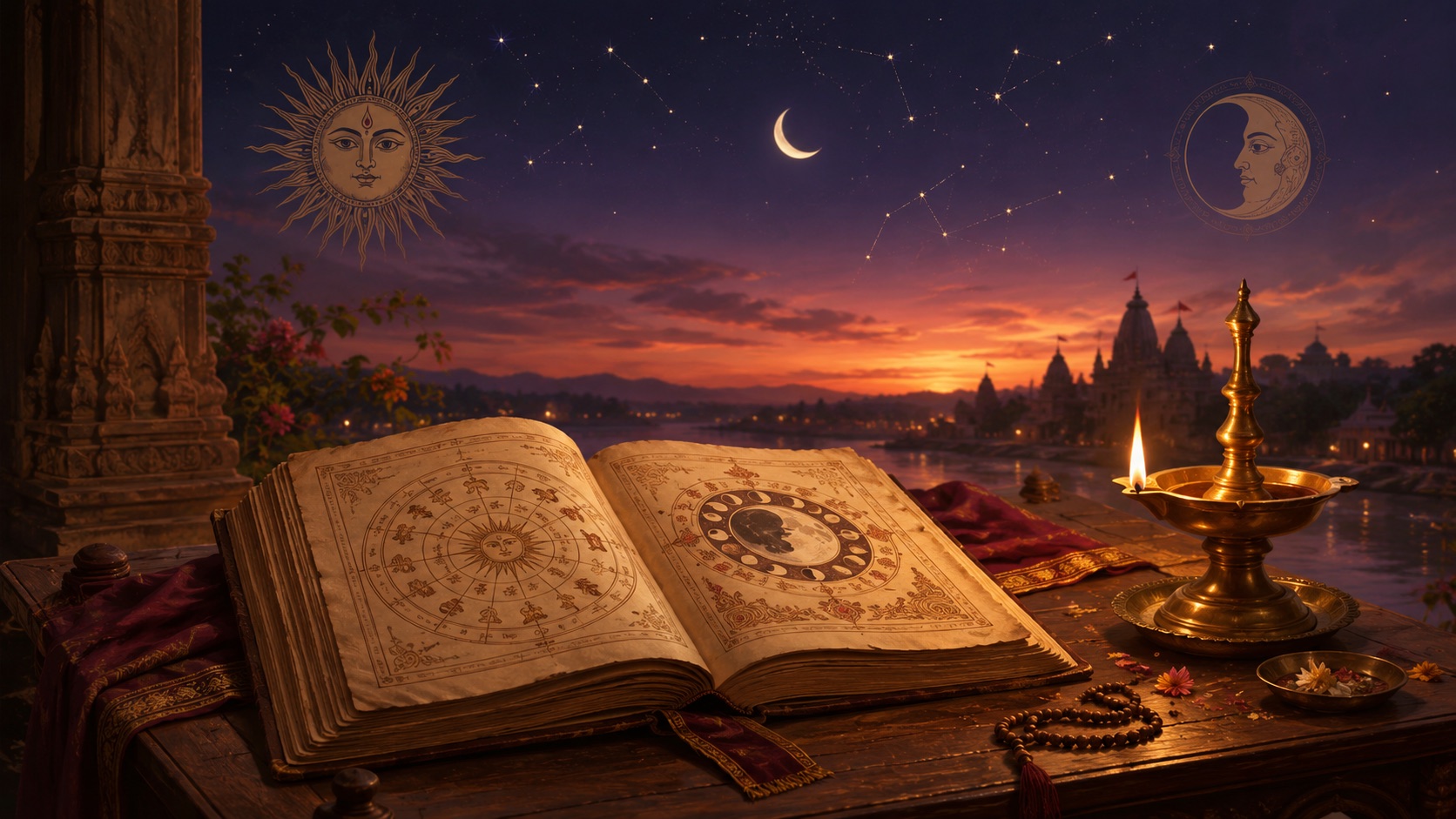
Open any traditional Hindu household calendar and you will find, tucked beneath the date, a dense little cluster of Sanskrit words — the tithi, the nakshatra, the yoga, the karana, the vaar. Together these make up the Panchang, the Hindu almanac that has guided when to farm, marry, travel, fast and worship for thousands of years. If you have ever wondered what all those terms mean, this guide walks through the Panchang from the ground up.
The word Panchang (also spelled Panchanga or Panchangam) comes from two Sanskrit words: pancha meaning "five" and anga meaning "limb". So a Panchang is literally "the five limbs" — five astronomical elements that, taken together, describe the quality of any given day. Once you understand these five, the rest of Hindu timekeeping opens up.
Why the Panchang exists
The Gregorian calendar most of us use for daily life is a solar calendar — it tracks the Earth's journey around the Sun and gives us fixed dates. The Hindu calendar is luni-solar: it tracks both the Moon and the Sun. That is why festivals like Diwali or Holi fall on different Gregorian dates each year — they are fixed to the Moon's cycle, not to 8 November or 14 March.
Because the Moon moves quickly and the Sun moves slowly, each day carries a unique combination of lunar and solar positions. The Panchang captures that combination in five readings, letting you know not just which day it is, but what kind of day it is.
The five angas (limbs) of the Panchang
1. Tithi — the lunar day
A tithi is the time it takes the Moon to move 12 degrees away from the Sun. There are 30 tithis in a lunar month — 15 in the waxing fortnight (Shukla Paksha) leading to the full moon, and 15 in the waning fortnight (Krishna Paksha) leading to the new moon. The tithi is the single most important element for festivals and vrats: Ekadashi, Purnima, Amavasya and Ashtami are all tithis. If you want the full breakdown, see our guide to the 30 tithis of the Hindu calendar.
2. Vaar — the weekday
The most familiar limb. Vaar is simply the day of the week — Ravivar (Sunday), Somvar (Monday) and so on — each ruled by a planet and associated with a deity. Monday is dedicated to Shiva, Tuesday and Saturday to Hanuman and Shani, Thursday to Vishnu and the Guru. This is why many people choose a particular weekday for a particular fast or worship.
3. Nakshatra — the lunar mansion
The sky through which the Moon travels is divided into 27 segments called nakshatras, or lunar mansions. The nakshatra tells you which "star" the Moon occupies on a given day, and it is central to naming ceremonies, matchmaking and muhurat. Your birth nakshatra is the one the Moon was in when you were born. Learn more in our guide to the 27 nakshatras and your birth star.
4. Yoga — the Sun–Moon angle
Yoga here does not mean postures. It is a calculation based on the combined longitudes of the Sun and Moon, producing 27 yogas with names like Vishkumbha, Priti, Ayushman and Siddhi. Some yogas are considered auspicious and some inauspicious, and they are one factor astrologers weigh when choosing a muhurat.
5. Karana — the half-tithi
A karana is half of a tithi, so there are two karanas in each lunar day and 11 karana types that rotate through the month. Karanas are used for finer timing decisions, particularly the "chara" (movable) and "sthira" (fixed) karanas, each suited to different kinds of work.
Beyond the five limbs: the timings people look up daily
Most people who check a Panchang today are not calculating yogas by hand — they want the practical timings that flow from these five elements. The most commonly consulted are:
- Rahu Kaal — the roughly 90-minute inauspicious window each day when new ventures are traditionally avoided.
- Choghadiya — the day and night split into auspicious and inauspicious slots, popular for travel and quick decisions.
- Abhijit Muhurat — the short, highly auspicious window around solar noon, good for starting important work.
- Sunrise, sunset and moonrise — the anchors from which almost every other timing is calculated.
Because all of these depend on the exact position of the Sun and Moon over your location, they shift from city to city — sometimes by many minutes. A Panchang calculated for Delhi is not quite right for Chennai or Mumbai.
How to actually read a Panchang
You do not need to memorise Sanskrit astronomy. In practice, reading a Panchang looks like this:
- Confirm the vaar (weekday) and its ruling deity.
- Note the tithi and paksha to know where you are in the lunar month — useful for fasts like Ekadashi.
- Check the nakshatra if you are planning a ceremony, naming or muhurat.
- Glance at the day's Rahu Kaal and Choghadiya to avoid inauspicious windows and find good ones.
The beauty of the Panchang is that it turns time from a flat sequence of identical days into a living rhythm — each day with its own texture, deity and mood.
A grounded perspective
The Panchang is a remarkable piece of inherited astronomy and devotion, and consulting it can bring intention and rhythm to your days. At the same time, it is a guide, not a cage. A sincere prayer offered during Rahu Kaal is not wasted, and a good deed done on an "inauspicious" tithi is still a good deed. Use the Panchang to add mindfulness to your timing, not anxiety to your life.
Related reading
- Tithi explained: the 30 lunar days
- The 27 nakshatras and your birth star
- Rahu Kaal today: what it is and how to calculate it
- Choghadiya today: good and bad muhurat times
- Today's Panchang for your city
Get today's Panchang for your city
See today's tithi, nakshatra, Rahu Kaal and shubh muhurat for your city with the free Naam Jaap Panchang.
Open the Panchang