Why 108 Beads? The Meaning Behind the Japa Mala
By Naam Jaap Editorial Team · July 4, 2026 · 4 min read
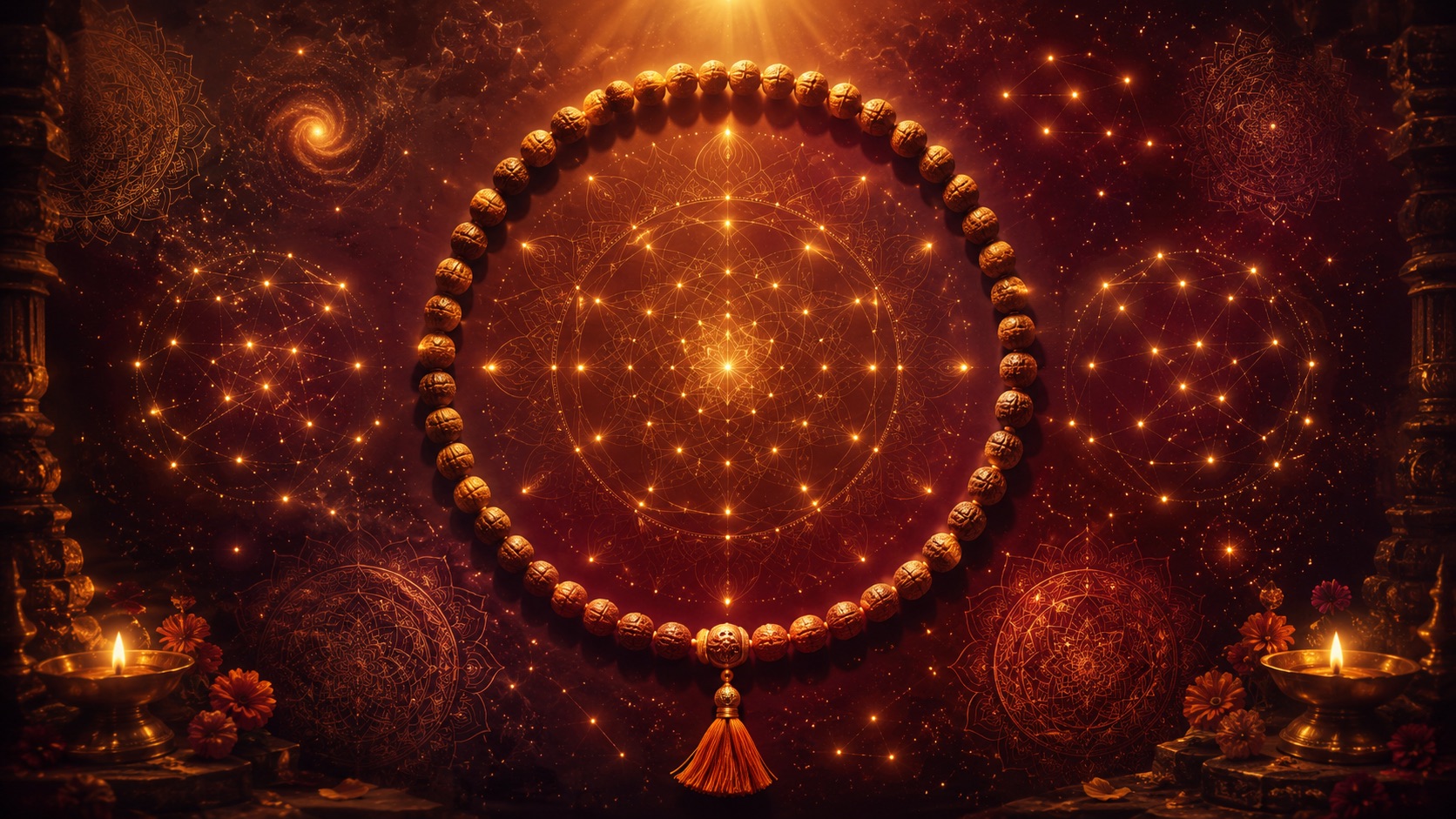
Ask why a japa mala has 108 beads and you'll get many answers — and remarkably, they all point to the same idea: that 108 represents wholeness, the union of the individual with the universe. Here's why this number is considered so sacred across Hindu, yogic and astronomical traditions.
The short answer
108 is regarded as a number of cosmic completeness. A japa mala has 108 beads so that one full round of chanting mirrors a complete cycle — of the cosmos, the self, and the divine. Let's look at the beautiful explanations behind it.
The astronomical reasons
Much of 108's significance comes from the sky:
- 27 nakshatras × 4 padas = 108. The Moon's path is divided into 27 lunar mansions (nakshatras), each with 4 quarters (padas) — giving 108 divisions of the heavens.
- 12 zodiac signs × 9 planets = 108. The twelve rashis multiplied by the nine grahas (Navagraha) of Vedic astrology also equals 108.
- The Sun, Moon and Earth. Ancient texts note that the distance from the Earth to the Sun is roughly 108 times the Sun's diameter, and the distance to the Moon about 108 times the Moon's diameter — a striking cosmic symmetry.
The scriptural and spiritual reasons
- 108 Upanishads. The principal spiritual texts of the tradition are traditionally counted as 108.
- 108 names of the deities. Gods and goddesses are honoured with lists of 108 sacred names (Ashtottara Shatanamavali).
- 108 sacred sites and marma points. There are said to be 108 holy places, and in yoga, 108 vital energy points (marmas) in the body, with 108 nadis meeting at the heart.
The numerology of 108
The digits themselves are said to carry meaning:
- 1 — the one, unity, the Divine or the higher truth
- 0 — emptiness, humility, or the completeness of creation
- 8 — infinity and the eternal
Together, 1-0-8 is read as "the individual moving from unity, through emptiness, into the infinite."
The guru bead — the 109th
Beyond the 108 counting beads sits one extra, larger bead: the guru bead (or meru). It is never counted or crossed. It represents the guru, the source and summit of the practice — the point you return to at the end of each round, honouring the teacher who lights the way.
Why it matters for your practice
Understanding 108 turns counting into contemplation. Each round of the mala isn't just "108 repetitions" — it's a small, complete journey through a sacred cycle, ending back at the guru. That's why a single, mindful mala is considered such a meaningful daily practice.
Frequently asked questions
Why does a mala have 108 beads?
Because 108 is considered a number of cosmic completeness in Hindu tradition — reflected in astronomy (27 nakshatras × 4 padas, 12 signs × 9 planets), the scriptures (108 Upanishads), and yoga. One round of 108 mirrors a complete cycle.
What is the significance of the number 108?
It symbolises the wholeness of the universe and the union of the self with the divine. Its digits are read as 1 (unity), 0 (emptiness/completeness) and 8 (infinity).
What is the 109th bead on a mala?
The larger 109th bead is the guru bead (meru). It marks the start and end of a round, is never counted, and represents the guru.
Do I have to chant exactly 108 times?
108 is the traditional round, but there's no strict rule. A short, consistent daily practice matters more than the exact count.
Count your japa with Naam Jaap
Chant and track your rounds and daily goal with the free Naam Jaap app.
Open Naam Jaap